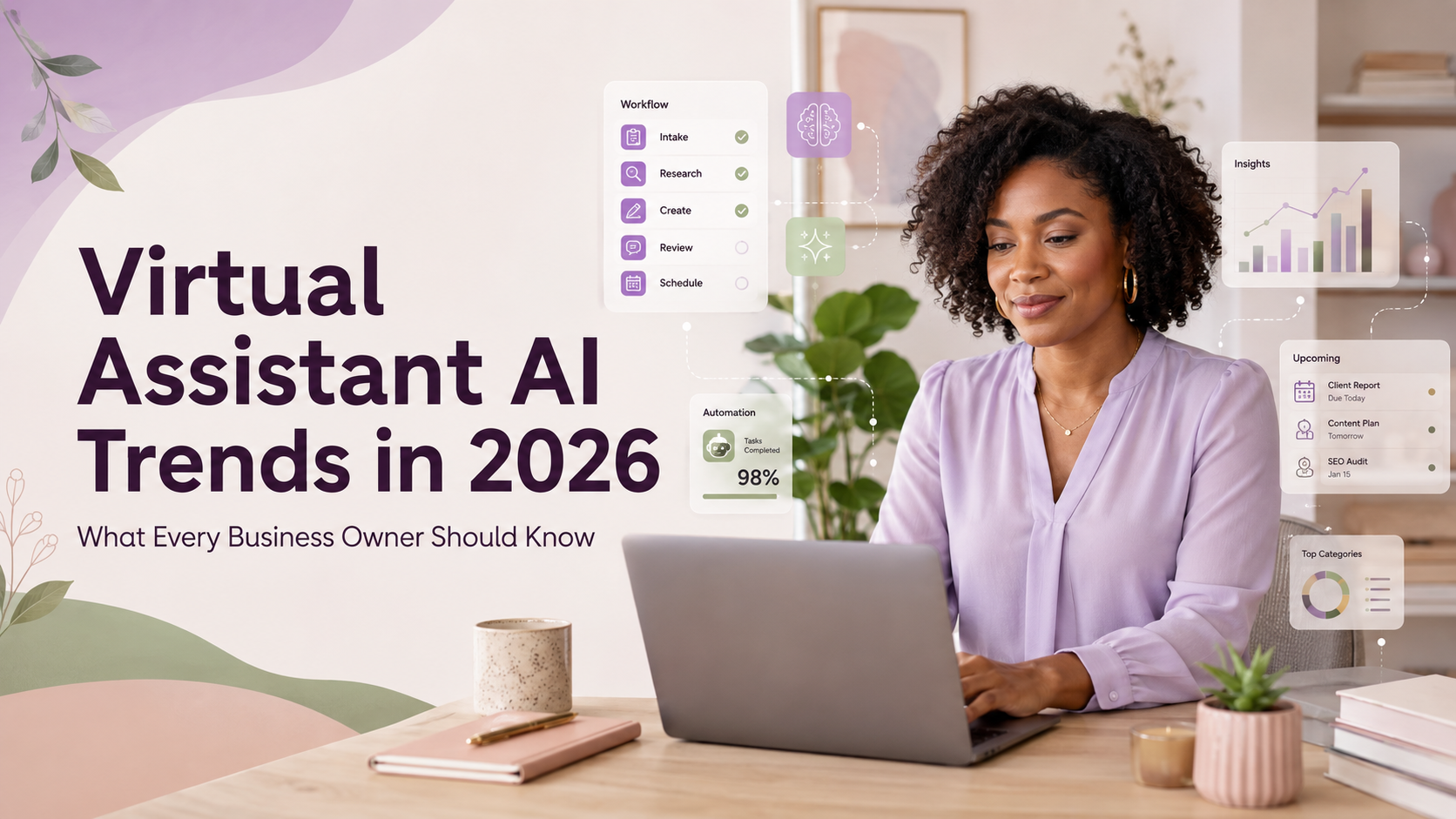
Virtual Assistant AI Trends in 2026: What Every Business Owner Should Know
Montiqua Charmaine
This post may contain affiliate links, which means Remote Blossom Co. may earn a commission at no additional cost to you.
If your LinkedIn feed has been full of virtual assistant talk lately, you're not imagining it. The virtual assistant industry is having a moment in 2026 — and AI is a big reason why. Industry forecasts put the virtual assistant services market at roughly $19.5 billion in 2025, on track to pass $55 billion by 2035, with small and mid-sized businesses as the largest group of clients. But the role itself has changed a lot in the last two years, and if you're deciding whether to hire a VA — or you already have one — it's worth understanding what's actually shifted.
Here are five virtual assistant AI trends shaping 2026, what each one means for your business, and the questions to ask before you hire.
1. AI-Augmented VAs Are the New Standard
The biggest myth about AI and virtual assistants is that AI is replacing them. It isn't. What's actually happening is more useful: skilled VAs are using tools like ChatGPT, Claude, and automation platforms like Taskade to do the same work faster and catch more of the details that used to slip through the cracks.
Think inbox triage that used to take an hour now taking fifteen minutes. Client onboarding that used to mean five separate manual steps now running as one automated workflow. Meeting notes, first-draft emails, and weekly reports that get drafted by AI and then checked and polished by a human who knows your business. The VA isn't gone — she's just not doing the repetitive parts by hand anymore.
What this means for you: if a VA can't tell you how they use AI in their process, that's worth asking about. It's no longer a nice-to-have; it's a productivity multiplier that's become baseline in this field.
2. Specialization Is Replacing the Generalist VA
A few years ago, "virtual assistant" mostly meant one person handling a little bit of everything. In 2026, more and more VAs are specializing — operations, e-commerce, content systems, CRM management, AI implementation, or industry-specific support like legal, healthcare, or travel.
Businesses are choosing depth over breadth. A specialist who deeply understands, say, Shopify operations or content systems will solve problems faster than a generalist juggling five unrelated skill sets.
What this means for you: the question isn't just "should I hire a VA," it's "what specifically do I need this VA to be excellent at." That clarity gets you a better match and a faster ramp-up.
3. Businesses Want Long-Term Partners, Not Gig Workers
The one-off task, gig-platform model is losing ground to ongoing retainer relationships. Market research on VA services shows dedicated monthly arrangements now make up the largest share of the market. Companies are treating VAs less like contractors and more like extensions of the internal team — integrated into SOPs, systems, and workflows instead of parachuted in for isolated tasks.
The reason is practical: a VA who stays with you learns how your business runs, so nobody's re-explaining "how we do things here" every few weeks, and the knowledge stays inside your business instead of walking out the door.
What this means for you: if you've been hiring VAs task-by-task and feeling like you're always re-onboarding someone new, a retainer relationship with one dedicated person solves that — and it tends to be more cost-effective than it looks on paper.
4. Trust and Data Security Are Now Deal-Breakers
As VAs get closer to sensitive business systems — client data, financials, CRMs — data security and confidentiality have become non-negotiable, not a nice bonus. Hiring a VA in 2026 is as much about trust as it is about skill. That includes how they use AI: pasting client information into a free AI tool without thinking about where that data goes is a real risk.
What this means for you: ask how a prospective VA handles client data, which tools they use, whether they'll sign an NDA, and how they manage passwords (a shared password manager is a good sign; passwords in a spreadsheet are not). A VA who takes this seriously will have a clear answer, not a shrug.
5. AI Fluency Is Becoming a Baseline Skill, Not a Bonus
Being comfortable with AI tools used to be a differentiator. It's quickly becoming table stakes — similar to how basic spreadsheet skills went from "impressive" to "expected" a decade ago. VAs who aren't building AI fluency into their workflow are going to feel it in 2027 and beyond.
5 Questions to Ask Before You Hire a VA in 2026
- How do you use AI in your day-to-day work, and where do you not use it?
- What kinds of businesses or tasks do you specialize in?
- How do you protect client data and passwords?
- What does your onboarding process look like in the first two weeks?
- How do you report on what you've done each week?
If You're Hiring a Virtual Assistant in 2026
The businesses getting the most out of virtual support right now are the ones treating it as a real operational partnership — not a stopgap. That means looking for someone who's specialized in what you actually need, comfortable using AI to work smarter (not just cheaper), serious about protecting your data, and open to a longer-term relationship instead of one-off tasks.
That's exactly how we built the Blossom VA Retainer at Remote Blossom Co. — ongoing support, real systems knowledge, and AI built into the workflow from day one, not bolted on as an afterthought.